

Parents constantly hear about the importance of reading to their young children. While some children immediately love story time, others quickly flip through pages or declare the dreaded “my read!” before taking the book from you. Busy little hands need something to do, and we sometimes need to build a bridge to loving book time. Here are my favorite books to foster a love of reading in your young child.
Tactile Books
Tactile books have components that you can touch, poke, or feel. They might be soft or scratchy. This added sensory input helps draw a young child’s attention and keeps them engaged.

No matter what animal or automobile your child is into, there is a version of this book for them! The simple, repetitive text and a sensory experience on each page make these a huge hit for younger toddlers. Don’t forget to add an emphatic finger wag and head shake as you say “that’s not my . . .” Extra points for silly voices!

I love these books by Jellycat. They’re similar to the That’s Not My books and have a touchable cut-out on each page. However, they are slightly more detailed and worth adding to your library list.

This is another extensive series of tactile books. The textures are silicone, and the images are fun and detailed. These books also include clever rhymes, which hook a child’s attention and support their language and sound awareness skills over time.

These fun, bubble-poking books cover a variety of topics and some beloved songs! It’s impossible not to find one your child will enjoy. The bubbles make a satisfying snap that some children will find more interesting than the rest of the book.
Books with Flaps or Windows
Children can’t resist looking for hidden pictures. The simple addition of a flap or sliding window, here and there, can transform the experience of looking at a book with a parent. As a bonus, it will also support the development of fine motor skills.

Admittedly, my partner and I find this book a little cringey as the narrator nonchalantly “sends back” a menagerie of animals they deem unsuitable. However, toddlers love opening the flaps and listening to the animal sounds. This quickly turns into imitation, then making the sounds on their own. The book also incorporates a variety of adjectives, which you might not use in your daily routine.

This is a year-round book in our household despite my attempts to hide it. “Dear Santa” provides vocabulary for common toys, opportunities for fun sounds (trumpet toots to Tutti Frutti, anyone?), and the same lovable interactive flaps as Dear Zoo.

The language in “Where’s Spot” is not as simple and repetitive as some of the other examples here, and younger children might not immediately understand that you are “looking” for a puppy. However, they will love opening flaps to reveal a hiding animal. This book provides many opportunities to model different animal names and sounds. There are also many household items depicted for naming and discussing. It is a great introduction to “where” questions and prepositions. These serve as a foundation for younger children and inspiration/practice for older children who are beginning to play hide-and-seek-type games.

Brown Bear is a beloved classic, and my absolute favorite is this slide-and-find interactive version. Your child may initially need some help with opening and closing the windows. However, when you combine the repetitive rhyming language with the interactive windows, this book quickly becomes a favorite. You can sing to this book or talk in a beat to emphasize the rhyme. I like to use gestures such as touching my chest for “I,” pointing to my eyes for “see,” and touching the page when I name the animal. Adding gestures can clarify meaning and provide a cue for a word. This can help your child combine words into phrases in no time.

This series contains engaging and detailed illustrations, plus fun tabs. My first introduction to the series was through a quick purchase at a second-hand store. Since then, I’ve been surprised at how much young children love them. The “Trucks” and “On The Go” books are a must if your little one loves automobiles. They provide great opportunities for less common vocabulary. When you finally see that fire engine in-person, you’ll be ready. What are those rolly doors called again?

It’s only a matter of time before any new parent becomes aware of the prolific work of Karen Katz. These books encompass many topics, including seasons and holidays, as well as the more mundane potty training and sharing. Many include large flaps, which children enjoy peeking under. They’ll come back to these stories again and again.
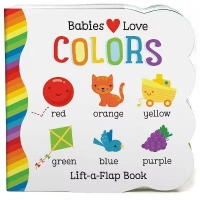
This is another book that caught me by surprise. We received one as a baby shower gift and now have several from the collection in our home. The bright pictures catch the attention of young readers, and the thick, large “flaps” of these board books are easier for chunky toddler fingers to open. There are many actions depicted in the books, which provide many opportunities to practice verbs. Action words often come after nouns and adjectives in language development and are just as important to label while sharing books with your little ones.
Song Books
Many children love songs. They are a great way to build a child’s social and language skills. There are so many resources now to help parents learn fun, age-appropriate songs. It’s important to sing with your child one-on-one, away from a video, so they don’t expect the screen every time. Combining beloved songs with books is a win-win. The images support vocabulary and understanding of the song, and the song helps build engagement and enjoyment of books. The repetition of the songs helps to build language skills in young communicators as they learn the words.

This one incorporates a favorite song with the Poke-a-Dot format. However, there are MANY versions of this beloved song in book form to choose from. You can’t go wrong.

My son’s love for Raffi hit hard around age two. These books help you learn the lyrics and sing with your child. They also contain beautiful visuals that enrich the storytelling experience. There is a book for many common Raffi songs. You are sure to find a match for the song your child requests over and over again:
- Baby Beluga
- Wheels on the Bus
- Shake My Sillies Out
- Down By The Bay
- Five Little Ducks
- Everything Grows
- If You’re Happy and You Know It
- Rise and Shine
Other Engaging Books

Sandra Boynton belongs in a category all her own when it comes to children’s books. Some are tactile (Dinosaurs Binket), some include songs (Snuggle Puppy, Silly Lullaby), and some include fun sounds that build a child’s anticipation and support imitation (Green Hat, Blue Hat, & Moo Baa Lalala). They also model key vocabulary to help children who are working on combining words (Opposites, and Green Hat, Blue Hat). The illustrations and stories are delightful and lighthearted. They are books my son comes back to over and over again, and ones I don’t mind reading with him, over and over again.

My one-year-old instantly gravitated to these board books. They encompass many daily routines and activities, providing rich context for modeling language. They include: “How We Eat,” “Hair,” and “Celebrations.” There aren’t many board books that include real pictures of children, and this is one reason why they are so engaging. You can also easily model verbs while talking about what’s happening in the images. Toddler vocabulary tends to be very noun-heavy. Emphasizing verbs can lead to more word combinations and more complex communication.
I hope you found some new ideas to support your child’s communication and learning journey. They don’t have to be on this list to be a great book for your child. Setting up a routine around books and reading, in itself, fosters interest and will support their interest in books over time. Don’t pressure your little one if they aren’t interested. Instead, look at a book while they’re nearby, make some fun sounds, and point out those fun textures or flaps. Sing a favorite song. Show off a favorite animal or car. If they see that you’re having a good time, they’ll join in soon enough. As always, meet them where they’re at. Happy reading!